
The best flooring for a kitchen starts at $2 per square foot for materials and tops $45, with installation adding $3 to $6, according to Angi’s August 2026 guide. That spread tells you the price is the smaller question. Kitchen floors take spills, dropped pans, chair scrapes and bare feet at 6 a.m., so the right answer depends on who lives in the house.
This guide ranks kitchen flooring options by household: kids, dogs, radiant heat and resale. It also covers the question people forget, which is whether the floor goes in before or after the cabinets. All figures are national. This guide found no independent county-level price data for Marin, Sonoma or Napa, so none is claimed here.
Kitchen flooring options at a glance
The table below uses Angi’s per-square-foot ranges, updated August 1, 2026, and its notes on each material. Angi’s headline figure is for materials only, with installation adding $3 to $6 per square foot, though it states a few entries such as bamboo and concrete as installed costs. Treat the cost column as a starting point.
| Material | Angi cost per sq ft | Water behavior | Main watch-out |
|---|---|---|---|
| Vinyl | $2 to $7 | Handles spills and humidity | Short life span, fades |
| Laminate | $3 to $13 | Not waterproof | Needs specific cleaners |
| Engineered hardwood | $4.50 to $16 | Less vulnerable than solid | Shows scratches and dents |
| Solid hardwood | $5 to $28 | Vulnerable to spills | High maintenance |
| Ceramic tile | $3 to $15 | Water-resistant | Cracks if you drop things |
| Stone tile | $5 to $45 | Porous, stains | Cold and hard underfoot |
| Cork | $3 to $11 | Naturally water-resistant | Pet claws damage it |
| Bamboo | $2 to $20 | Not waterproof | Fewer design options |
| Concrete | $2 to $16 | Weak against moisture | Needs sealing |
Two rows deserve a second look. Angi says waterproof cork costs $5 to $9 per square foot, and that solid hardwood labor accounts for $3 to $6 of its cost. Maintenance is part of the price too. Angi says stone needs sealing every few years, concrete needs a protective sealant and laminate needs specific cleaners, so a cheap floor with fussy upkeep is not always the cheap choice.
Our overview of the best materials for a kitchen remodel shows how a floor sits beside cabinet and counter choices, and our countertop materials guide covers the surface above it.
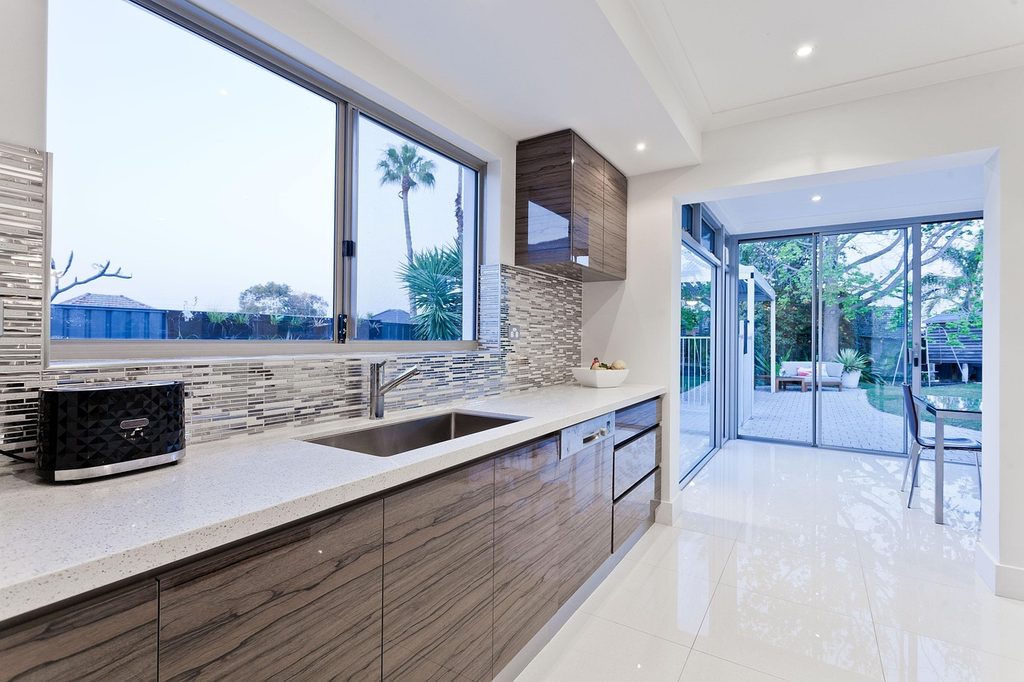
Best flooring for kitchen households with kids
Vinyl and tile for busy family kitchens
Kids spill, drop and slide, so the sources reviewed point to vinyl and tile. Angi lists vinyl as the best match for households with kids and pets, because it is made of layers that add durability and some varieties include a waterproofing layer. It lists ceramic tile as water-resistant, so spills and splashes will not damage it permanently.
Checking the vinyl wear layer
The wear layer is the number to check on vinyl. A mil is one-thousandth of an inch, not a millimeter. The Flooring Company, a retailer, says in a February 2026 post that 12 mil suits low-traffic rooms and that 20 mil suits kitchens and homes with children. That is one seller’s view, but it matches how a thicker layer wears.
Tile cracking and slip resistance
Tile has a different weak spot. Angi warns that dropped items can crack it. Slip resistance matters for bare feet and socks, but a single rating does not tell you everything. The Tile Council of North America’s FAQ on friction says the measured value is not synonymous with slip resistance and does not predict whether anyone will slip. Under the 2021 standard, interior wet-use tile needs a wet DCOF of at least 0.42 or a manufacturer declaration.
Vinyl and laminate trade-offs
Vinyl has trade-offs that the wear layer does not fix. Angi’s cons for vinyl are that it emits VOC emissions, has a shorter life span than tile and is vulnerable to fading. Ask the maker for emissions documentation and a written warranty before you commit. Laminate carries its own con in Angi’s list, which is that it is a less sustainable option.
Layout matters here too. For planning around how your family moves, start with our smart kitchen design tips and think about where kid traffic meets the cooking zone.
Kitchen flooring for dogs, cats and claws
For pets, the ranking flips in places. Angi says vinyl suits households with pets, and the retailer above recommends a 20 mil wear layer for homes with dogs. Angi’s notes on tile mention cracking and, for stone, porous staining, but they do not flag claws as a problem for either.
Cork is the clear exception. Angi says pet claws can easily damage it and calls it not good for homes with pets. Hardwood is a mixed case. Angi says engineered hardwood is as easy to scratch and dent as the solid kind, and it says scooting chairs without floor protectors can scratch solid wood. A dog with long nails will find the same weak points.
Bamboo resists scratching and denting according to Angi, but it is not waterproof, so a water bowl zone needs care. Our tips to help you save when remodeling explain where to put your money if a pet is the main reason for the change.

Kitchen flooring over radiant heat
Wood temperature and humidity limits
If you plan heated floors under kitchen flooring, the surface material sets a temperature ceiling. The National Wood Flooring Association’s installation guidelines, revised in 2025, say the surface of an installed wood floor should never exceed 80 degrees Fahrenheit unless the maker specifies otherwise. They also set a normal interior range of 30 to 50 percent relative humidity and 60 to 80 degrees.
Vinyl, laminate and engineered wood over radiant heat
Lowe’s radiant heat guide gives a higher number for other materials. It says most vinyl cannot exceed 85 degrees, rigid-core vinyl performs best, and laminate must be rated for radiant heat. It also says solid hardwood can gap, cup or crack, while engineered hardwood is widely approved. Over concrete, it calls for a vapor barrier under vinyl and laminate.
The Lowe’s page does not cover tile, and this guide found no tile temperature cap from a primary source. Ask the tile maker and the heating supplier to confirm the limit in writing. Heated floors are far easier to plan than to retrofit, so settle them early, and ask whether the flooring maker’s warranty allows the system you have in mind. Our guide to bathroom tile and flooring shows how this question plays out in a wet room.
Kitchen flooring and resale value
Published cost-recovery estimates
If a sale is within a few years, wood floors have the best published numbers. The National Association of REALTORS’ 2022 Remodeling Impact Report says refinishing hardwood floors recovered 147 percent of cost and new wood flooring recovered 118 percent. Those figures come from NARI member estimates, so they reflect opinion, not sale prices.
The same report puts a kitchen upgrade at 67 percent cost recovery. The 2022 edition is the one this guide could read in full, so treat the numbers as older, national and indicative. They do not say a wood kitchen floor will beat tile in your Marin or Sonoma neighborhood.
Refinishing existing hardwood
The practical reading is narrower. If you already own sound hardwood that runs into the kitchen, refinishing is a strong value, and Angi lists resale value among the pros of hardwood. If you do not, wood in a kitchen asks for spill discipline. Our guide to planning a modern kitchen remodel without overspending shows where flooring ranks among the bigger budget lines.
Kitchen flooring comfort for cooks who stand
Hard floors punish tired feet. Angi says cork stays warm and feels comfortable underfoot, even barefoot in winter, and lists that warmth among its pros. It also describes stone as cold and hard, brick as hard underfoot and concrete as less comfortable.
Comfort matters most in the work triangle between sink, stove and fridge, where you stand longest. A good anti-fatigue mat is the cheapest fix and works on any floor. Angi does not rank engineered wood or vinyl on comfort, so any claim that they feel softer than stone is a design judgment, not a sourced finding.
Our list of kitchen layout mistakes is a useful companion here. Standing zones follow the layout, and the floor should follow the zones.
Floor before cabinets or after
Glued or nailed hardwood and ceramic tile
Remodelers disagree on this, and the honest answer depends on the floor type. Floor Coverings International, a franchise, says to put glued or nailed hardwood in before cabinets for a continuous floor. It says the same of ceramic tile, and it adds that wall-to-wall tile helps appliances sit at the right height.
Floating floors and fixed cabinetry
The same page says floating vinyl and laminate go in after the cabinets, because cabinets set on top of them would block the small movements those floors need. The NWFA agrees on the principle for wood. Its guidelines say floating floors should not go where fixed cabinetry such as an island will lock them down.
Some retailers recommend the opposite order for everything, so do not treat any one page as the rule. Ask the installer, cabinet maker and floor supplier to agree on the order before demolition ends. That choice affects appliance height, future repairs and your work schedule, so settle it while the project is still on paper.
Ranking the best flooring for a kitchen by household
Putting it together, here is how the evidence sorts the best flooring for kitchen use. For kids and spills, rigid-core vinyl with a thick wear layer or well-rated tile comes first. For large dogs, 20 mil vinyl and tile are the more forgiving choices in the sources reviewed, with cork out. For radiant heat, engineered wood and vinyl are approved with the 80 and 85 degree caps above, and tile needs written confirmation from the maker.
For resale value, existing hardwood that is refinished has the strongest published case, with new wood next. For tight budgets, vinyl and laminate carry the lowest published ranges, and laminate is not waterproof. For underfoot comfort, Angi’s notes favor cork over stone and concrete.
I tell clients to pick the floor by the messiest thing that happens in their kitchen, not by the photo. If you are comparing it with cabinet colors, see our overview of top kitchen cabinet trends and our look at open-concept kitchen ideas if the floor continues into another room. A kitchen and bath designer can keep those choices consistent across rooms.
FAQ
Cost of kitchen flooring for a typical kitchen
Multiply the area by Angi’s per-square-foot range. In a 200-square-foot kitchen, vinyl materials at $2 to $7 come to $400 to $1,400, and engineered hardwood at $4.50 to $16 comes to $900 to $3,200. Angi’s installation add-on of $3 to $6 per square foot adds $600 to $1,200. That is simple arithmetic on one source, and real quotes will differ.
Waterproof versus water-resistant
Angi calls vinyl and tile water-resistant and says laminate, bamboo and engineered hardwood are not waterproof. Waterproof cork is sold at $5 to $9 per square foot. Ask the maker which claim covers the surface, seams and core, because a floor can resist spills and still fail at a plank edge.
Slip resistance ratings for tile
Look for the manufacturer’s product use classification under the 2021 ANSI A326.3 standard. TCNA says interior wet-use tile needs a wet DCOF of 0.42 or a manufacturer declaration, and that the number cannot predict whether a person will slip. Use it to compare tiles, then test a sample underfoot with wet socks.
Your next step is a conversation
Still weighing wood, tile and vinyl? Book a free discovery call. It is an honest conversation about your home, with no sales pitch and no obligation. Ask for our free “Planning your remodel budget” guide while you are there, and use the contact page to start. You can also see how a project runs, from first sketch to final walkthrough, on the our process page.