
Kitchen cabinet cost is usually quoted per linear foot, and the published ranges for 2026 run from roughly $100 to $300 for stock, $150 to $650 for semi-custom and $500 to $1,200 for custom, according to Angi. Other sellers publish bands that sit far above or below those. Before you trust any single number, you need to know why the sources disagree.
This guide puts the published ranges side by side, explains what the three tier names do and do not tell you, and shows where cabinets sit in the whole budget. This guide found no independent cabinet price data below the San Francisco metro, so nothing here is a Marin, Sonoma or Napa figure. If you are still planning the room, our guide to planning a kitchen remodel without overspending puts cabinets in context.
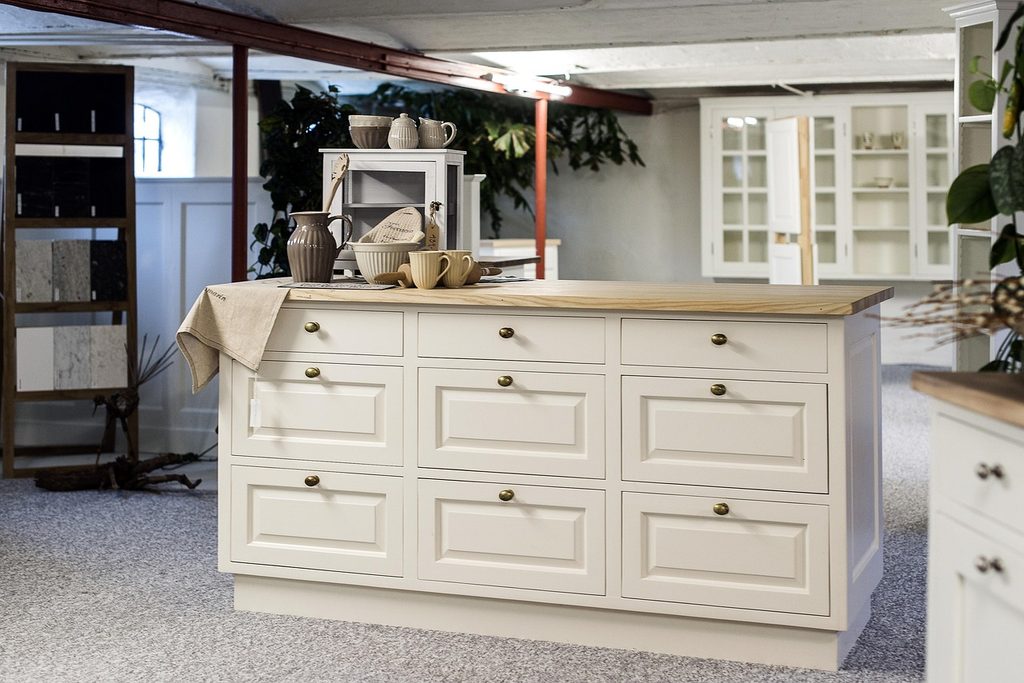
Published price ranges by tier
A linear foot is the length of cabinet run along the wall, measured across the fronts. A typical kitchen has 20 to 30 linear feet of base and wall cabinets together, which is why the Cost vs. Value model kitchen uses 30. The table below multiplies each published range by 30 feet so you can see what a mid-size kitchen would imply. The multiplication is this guide’s arithmetic, not a quote.
Published per-foot ranges
| Source and basis | Stock per foot | Semi-custom per foot | Custom per foot |
|---|---|---|---|
| Angi, national, August 2026 | $100 to $300 | $200 to $650 | $500 to $1,200 |
| Captivating Cabinets, dealer, installed | $150 to $250 | $250 to $400 | $400 to $650+ |
| Fedor Fabrication, Pennsylvania, installed | $160 to $600 | $480 to $1,200 | $1,000 to $2,400+ |
What a 30-foot kitchen could cost
For 30 feet, the Angi ranges imply about $3,000 to $9,000 for stock, $6,000 to $19,500 for semi-custom and $15,000 to $36,000 for custom. The Captivating Cabinets bands imply roughly $4,500 to $7,500, $7,500 to $12,000 and $12,000 to $19,500. The Fedor Fabrication bands imply a custom kitchen of $30,000 to $72,000.
Why the published ranges differ
The sources do not agree, and averaging them would hide the conflict. Angi’s own pages, including its cabinet installation page, give two different lows for semi-custom, $100 and $200 per foot, and it is not clear which figures include installation. Fedor’s custom band starts above the top of Angi’s. Differences in region and door material, hardware choices and what the seller counts as a tier explain much of the spread.
How to use these figures in a Bay Area budget
For a Bay Area budget, treat these as a way to rank the tiers, not as a price. A contractor-published planning range for a mid-range Bay Area remodel puts cabinets and hardware at $12,000 to $25,000, according to Aziz Construction, a page dated 1 August 2026. That is a contractor’s planning range, not a measured average. Our look at saving when you remodel explains where else the money goes.
Meaning of the three tiers, and where the label misleads
Under those labels, stock cabinets come pre-built in fixed sizes, usually in 3-inch width steps from 9 to 48 inches, with a short menu of finishes. Semi-custom cabinets start from a catalog but let you change width, depth, height, finish and some interior parts. Custom cabinets are built to your dimensions and specifications. Those definitions agree across Angi, Captivating Cabinets and Aziz Construction.
What the tier labels do not tell you
The tier name says less than it appears to. Captivating Cabinets, a dealer, describes stock, semi-custom and custom as supply-chain categories, and says the tier tells you nothing about box construction: plywood versus particleboard, drawer joinery, hinges and hardware vary independently. Angi notes that construction-grade stock is often medium-density fiberboard, which fits the same point from the other side.
So a semi-custom line with plywood boxes and dovetailed drawer boxes drawers can beat a custom line with thin boxes, and the reverse is also possible. Compare the specification sheet, not the word on the quote. Our overview of kitchen remodel materials explains what each material does in daily use.
Width changes, fillers and fit
The width steps matter more than they sound. Because stock widths step in 3 inches, a wall run that is not a multiple of 3 leaves a gap, and filler strips and trim close it. Kitchen Cabinet Kings lists filler and trim among the items to confirm before you order. Semi-custom width changes remove many of those gaps, and custom removes all of them, which is where a tighter fit and a higher price come from.
Finish choices across cabinet tiers
The finish menu is the clearest difference in practice. One seller reports 6 to 20 stock finishes against 50 to 200 or more in semi-custom, and those counts are that seller’s own, not an industry standard. If you want a specific paint color or a two-tone layout, the line limits your options before price does, as our two-tone cabinet guide explains.
Factors that move cabinet price inside a tier
Construction and hardware choices
The National Kitchen & Bath Association lists the variables in its cabinet cost considerations: construction quality, materials, finishes, door style, hinges, joints, hardware, drawer glides and storage options. Doors with added molding cost more than plain ones. The page is from 2012, so use it for what drives price, not for any dollar amount.
Built-in storage and upgraded features
Its most useful sentence is that the cost of a basic cabinet box can easily double with several built-in storage sections, an upgraded finish or raised-panel door, and quality hinges and hardware. So add-on features such as pull-out organizers can move a kitchen up a price band without changing the tier name.
Cabinet construction and configuration
NKBA adds three more rules. Frameless cabinets tend to cost more than face-frame cabinets and take longer to install. Several small cabinets cost significantly more than fewer, larger ones in the same space. Adjustable shelves cost more than fixed ones. Hayden Island Cabinets says on its cost page that lower cabinets usually cost more than wall cabinets because they use more material, while wall cabinets cost less each but add up in number.
Storage and pantry decisions
Storage choices also shift the number. A pantry wall of tall cabinets costs differently from open shelving, and our notes on pantry design show how much storage a household needs before it buys it. Our smart kitchen design tips cover the daily-use side.
When refacing may cost less
If your goal is lower cost, NKBA says cabinet refacing costs about half of comparable new cabinets, but only when the layout and cabinet positions stay and the boxes have not sagged. Our guide to maximizing kitchen space shows why storage design matters before you spend on boxes.
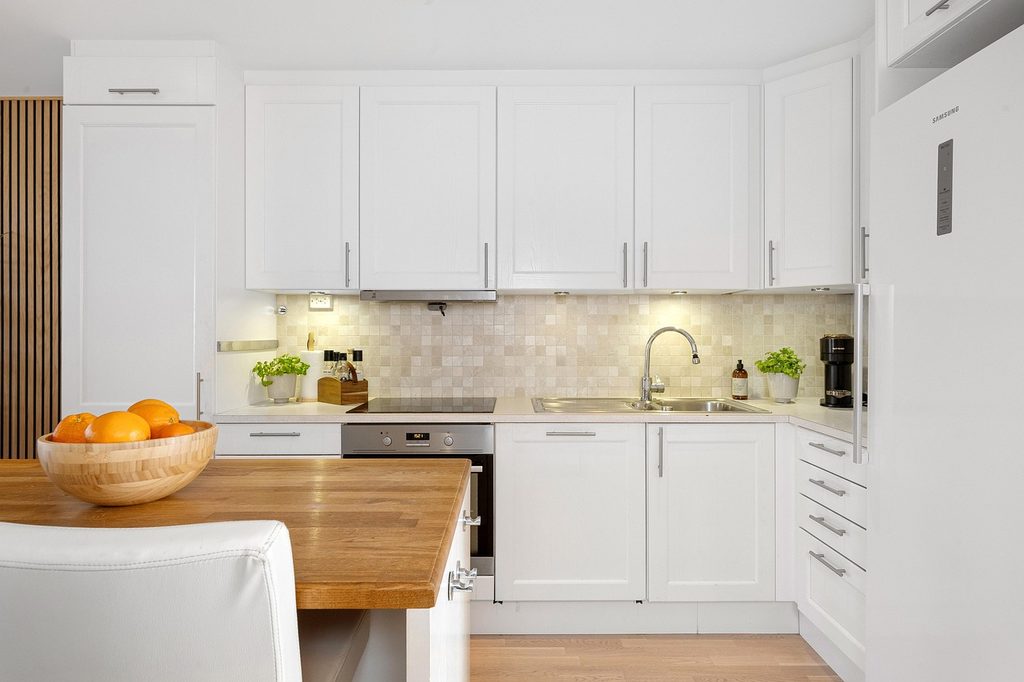
Cabinet cost inside the whole kitchen budget
Where cabinets fit in the kitchen budget
NKBA’s budget guideline, reproduced in a PDF from Welling Kitchen & Bath, puts cabinetry and hardware at 29 percent of an average kitchen remodel, with installation at 17 percent and appliances at 14 percent. The copy is a 2019 upload of an undated original, so read it as a rule of thumb.
How cabinet tier relates to total remodel cost
The Cost vs. Value report shows how tier choice sits inside a bigger number. Its major midrange model uses 30 linear feet of semi-custom wood cabinets and costs $97,667 in San Francisco in the 2025 report, and its upscale model uses 30 feet of top-of-the-line custom cabinets and costs $192,231, according to Zonda and JLC. Do not read that gap as the price of custom cabinets, because the upscale model also changes counters, appliances and more. It shows only that a custom tier usually arrives with other upgrades.
The closest metro in the data is San Francisco, and it is not Marin, Sonoma or Napa. To price the next-biggest surface in the room, read about countertop materials.
Lead times and why they differ
Lead time is a hidden cost too, because a kitchen without cabinets stalls the whole job. The sources disagree here too, as the table shows.
Published cabinet lead times compared
| Source | Stock | Semi-custom | Custom |
|---|---|---|---|
| Kitchen Cabinet Kings, July 2026 | 1 to 4 weeks | 4 to 6 weeks | 6 to 12 weeks |
| Captivating Cabinets, 2026 | Days to about 2 weeks | 4 to 8 weeks | 8 to 16+ weeks |
| Angi, August 2026 | Not given | 1 to 2 weeks | 6 to 8 weeks |
Why lead times vary
For stock, Kitchen Cabinet Kings gives 1 to 2 weeks for ready-to-assemble and 2 to 4 for assembled cabinets. Angi’s semi-custom figure of one to two weeks looks short next to the other two, and it is not safe to plan around it. The Kitchen Cabinet Kings page lists the usual causes of delay: backorders, freight scheduling, seasonal demand and the year-end shutdown, and orders placed before the appliance dimensions, ceiling height and trim were confirmed.
Hayden Island Cabinets publishes no lead times on its site, so ask your dealer for a written date and plan the ordering window early. Our process page shows where ordering falls in a remodel.
Hayden Island lines as a worked example
Our studio is an authorized dealer for Hayden Island Cabinets, and its cabinet lines page shows how line choice changes what you get. Hayden Island does not publish prices, so this section describes the structure, not the cost.
How the Hayden Island cabinet lines differ
The Cornerstone line is described as Shoreline trimmed down to compete with production cabinets, built frameless in the European style. Shoreline offers glazes, sheens and distressing. The Hayden Bay lines are framed, with overlay doors or inset doors, and the overlay line lists solid wood face frames, dovetailed solid wood drawers and full-extension soft-close guides. Its boxes are listed as 1/2-inch MDL or plywood.
Finish limits in the Cornerstone line
The finishes page shows the trade in practice. The Cornerstone line offers only four paints, white, linen, vanilla and graphite, leaves out six stains, offers only black and brown glazes, and has no distressing. So a budget line can fully serve a white or graphite kitchen and cannot serve a green one.
Choosing the lowest tier that fits your needs
The right tier is the cheapest line that gives you the door style, finish and storage you will use daily. A plain door in a calm finish, the kind we describe in our minimalist kitchen design guide, keeps the price down in any line, because NKBA notes that molding adds cost. Our cabinet trends guide can help you decide which finishes are worth paying for.
Getting quotes you can compare
Build a quote with matching specifications
Ask every supplier for the same written specification: box material and thickness, face frame or frameless, door style and finish, drawer box material and joinery, hinge and glide brand, and whether the quote includes delivery and installation, filler and trim, and hardware. Without that, three quotes will not compare, because the tier label hides the differences that set the price.
Give suppliers the same measured plan
Send each supplier the same measured plan as well, so every quote prices the same layout. NKBA warns that you must specify and size the components accurately, particularly with frameless cabinets, and that a dealer’s staff or an independent NKBA designer can do it. That is where a kitchen designer earns the fee, as our post on working with a kitchen and bath designer explains.
Confirm the cost of changes after ordering
Finally, ask what a change order costs once cabinets are on order. Kitchen Cabinet Kings warns that orders placed before dimensions are confirmed trigger costly reorders.
FAQ
Refacing versus replacing
NKBA says cabinet refacing costs about half of comparable new cabinets when the layout and cabinet positions stay the same. It does not work if the boxes have visibly sagged or storage is too small.
Frameless versus face frame cost
NKBA says frameless cabinets tend to cost more than face-frame cabinets and take longer to install. NKBA adds that precise measurements matter, especially for frameless.
Timing for ordering cabinets
Order after the measured plan is final and the appliance sizes are confirmed. Published lead times run from days for stock to 16 weeks or more for custom, so ask your dealer for a written date before demolition begins.
Next step: a plain conversation about cabinets
If you want a specification-level quote comparison, book a free discovery call. It is an honest conversation about your home, with no sales pitch and no obligation. Ask for our free “Planning your remodel budget” guide, then reach us through the contact page. You can read about our studio, see client reviews, or review how a project runs, from first sketch to final walkthrough.