
Design-build vs design-bid-build comes down to two questions: who draws your plans, and who checks the work once building starts. With a design-build model, one company holds both jobs. With a design-bid-build model, a designer draws the plans and you hire a contractor separately. Neither is the right answer for every kitchen or bathroom.
The honest comparison is less tidy than most contractor blogs suggest. The best-known research covers commercial and highway projects, not kitchens, and the two big studies disagree. This guide lays out where each model wins, says where Projects Within Reach sits, and covers the California contract rules that protect you either way. If you are still deciding whether to hire a designer at all, our post on the benefits of working with a kitchen and bath designer is the place to start.
Design-build and design-bid-build in plain terms
How each delivery model is structured
The American Institute of Architects’ contract documents team describes both models in plain terms. In a design-bid-build job, the owner hires a design team to produce drawings and a project description. In a design-build job, the owner hires a single company to create the drawings and build the project.
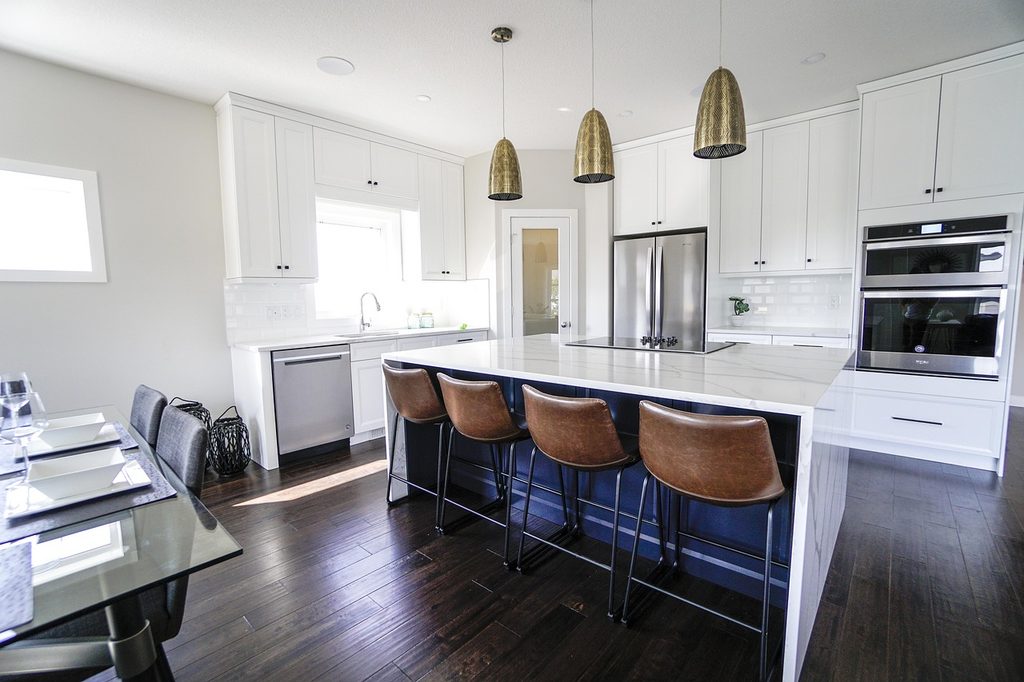
Translate that to a kitchen. In the first model you sign a design agreement with a designer and a separate construction contract with a licensed contractor. In the second you sign one contract with a firm that employs or partners with both.
Where the models differ
Both models can produce a good kitchen. They differ in who carries the risk, who answers to you, and when the price becomes firm.
Differences between the models on a kitchen or bath job
Most of the difference shows up in five places: the contracts you sign, the drawings, the bids, the site checks, and the change orders. The table pairs the AIA, Procore and Realm descriptions with a remodel lens, so read it as this guide’s summary and not a legal definition.
The models compared for a remodel
| Question | Design-build | Design-bid-build |
|---|---|---|
| Who do you sign with? | One firm for design and construction | A designer, then a separate contractor |
| When is the price firm? | As the design develops, since design and pricing run together | After drawings are complete and bid |
| Who checks the work? | The firm’s own team | The designer, as an outside check |
| Who prices changes? | The same team that builds them | The contractor, and the designer can review it |
What complete plans change about bids
Procore notes that design-bid-build allows complete design before bidding, so contractors can sometimes give more accurate bids. Procore also says a design-build bid is hard to make accurate without complete design, so a firm number may arrive later. It adds that owners keep more control because they pick the design and construction teams separately. Our guide to planning a modern kitchen remodel without overspending covers the budget side of that choice.
The research findings and the limits of that research
What the Construction Industry Institute study found
Design-build fans quote a headline number. The Design-Build Institute of America (DBIA) summarizes a Construction Industry Institute study of 212 projects. It reports design-build at 3.8 percent less cost growth, 36 percent faster construction and 102 percent faster delivery from design through completion than design-bid-build. Those projects were industrial, office, high-tech and multi-story dwellings, and DBIA is a trade group that promotes design-build.
What the highway study found
The Federal Highway Administration looked at highway projects and reached a murkier answer. Project managers estimated design-build cut delivery time by 14 percent on average. But in a small sample of comparable projects, design-build’s total cost growth averaged 7.4 percent, against 3.6 percent for design-bid-build. The report was published in 2006 and rests on earlier project data.
What the research does and does not establish
Read together, the studies show that delivery method is not a guarantee of savings. This guide found no published data on kitchens or bathrooms, and none for Marin, Sonoma or Napa. A claim that design-build is “faster and cheaper” for a home remodel is a sales line, not a finding. Treat the studies as a reason to ask questions, and not as a verdict on your home project.
Strengths of the design-build model
Schedule and cost coordination
Design-build has real strengths. Procore points to schedule compression, since construction can begin on early phases before the final design is done. For a remodeler, that can mean ordering long-lead items while drawings finish. A single contract also means one firm answers for both the drawings and the build, which removes the handoff gap between designer and contractor.
When design-build may suit the project
Realm, a firm that works with design-build companies, says the model tends to work better for projects with complex permitting, significant layout changes and tight budgets, because design stays anchored to cost. If you want to move a sink, open a wall and keep the number honest, a firm that prices while designing can save you a round of redesign.
Trade-offs and oversight under design-build
Design-build has failure modes too. Realm names template-driven design, particularly at firms that specialize in volume ADU and bathroom work, and reduced oversight, since the designer and builder are the same organization. Design-build also suits owners who want to hand off decisions. Procore says those owners give up much of the control but reduce their risk. If you do not want to run bids, that trade is reasonable. Our look at smart kitchen design tips shows what the design phase should settle first.
Strengths of the design-bid-build model
Independent review during construction
The strongest case for design-bid-build is real independence. Realm lists it as the better fit for high-end custom work, for owners who already trust a designer, and for projects with a stable scope. Its argument is that a designer who does not work for the contractor can review the work against the plans, and an in-house designer cannot play that role.
Competitive bids against the same drawings
Bids are the second case. Four Brothers, a builder in the Washington, DC area, says bids are only comparable when they are priced against the same drawings. That is the quiet strength of this bid-based model: three contractors price one set of plans, and you can read the differences. Procore adds that open bidding can drive prices down.
Cost and coordination risks
There is a cost of independence. Realm describes a common failure: plans developed without real-time cost feedback come back over budget. It also describes designer and contractor disagreeing during construction, which leaves you in the middle. Procore adds that change orders after construction starts add cost that passes to the owner. Ask any designer how cost feedback reaches the drawings before bids go out. Our list of kitchen layout mistakes designers avoid shows where drawings tend to go wrong.
The designer-led version of design-bid-build
How the studio uses design-bid-build
Projects Within Reach follows the second model. According to the studio’s description, the designer draws the plan and advocates for you while a separately hired contractor builds it. The studio’s process runs from a discovery call to completion, and its site describes a trusted network of professionals who bring the design to life.
The outside review and two-contract trade-off
That structure gives you an outside check on the contractor, which is the advantage Realm credits to the separate model. The studio is led by Jenn Watkins, CKBD, and its about page explains her background. The trade-off is plain. You sign two agreements, and you are the one who hires the contractor. A design-build firm would hold one contract and one schedule, and that convenience has real value.
Bring cost into the design conversation
Where the models meet is budget talk. Design-bid-build works best when cost is raised at the beginning, not after the drawings are done. Our tips to help you save when remodeling show where a designer and contractor can trim a budget before bids go out.
California protections that apply under either model
What a California home improvement contract must include
The Contractors State License Board (CSLB) says California requires a written contract for home improvement projects over $500. The contract should describe the products and work in detail, include a written payment schedule, say who gets permits, give a completion date, and show the contractor’s license number.
Down payments and written change orders
The CSLB also caps the down payment at $1,000 or 10 percent of the contract price, whichever is less. Price or scope changes must go through a written change order signed before the change. These rules cover the construction contract in either model, so a design-build firm and a separate contractor both have to follow them.
Ask how design fees are documented
Ask how a design fee is handled in the paperwork. This guide could not confirm whether a design retainer counts under the deposit rule, so ask the firm and check with the CSLB. A good contractor will show you the license number and answer without hurry.
Questions to ask before you sign
Questions for a design-build firm
Realm’s list of questions for design-build firms is a useful start. Ask whether you can bring in an independent designer for part of the job. Ask what happens if you want a design change after plans reach the city. Ask to see three past projects at a similar scale. Ask who owns the drawings if you part ways. Ask how the firm handles what you want when it cannot be built at your budget.
Questions for an independent designer
For the separate model, flip the questions. Ask the designer how they manage cost during the design phase so the bids do not surprise you. Ask which contractors they have worked with in your market, how often they visit the site, and what happens if the lowest bid comes in over the design budget.
Check the firm’s past work
Check the answers against the track record, not the pitch. The studio’s reviews page and gallery show finished work, and you can ask any firm for the same.
Choosing by project type
When a simpler project may need less design
A like-for-like refresh of surfaces and fronts leaves little to design, so a contractor-led or design-build job can be simple. A bathroom with a layout change and permits fits a design-build firm well, per Realm’s view of complex permitting. Our guide to planning a guest bathroom renovation budget helps you size that kind of job.
Choose a model for the project and support you want
A kitchen where the layout is the point, or where you want a designer on your side during construction, fits the design-bid-build route better. The same is true if you want to compare bids against one set of drawings. If you cannot decide, pick the model that matches who you trust to say no when the cost climbs. A designer-led job suits owners who want someone on their side, and a design-build firm suits owners who want fewer moving parts. Both are legitimate starting points, and our guide to kitchen remodel materials can help you price the finishes either way.
FAQ
Speed of design-build on a small remodel
Procore says design-build can compress a schedule because construction starts before design is complete. The big numbers come from DBIA and FHWA studies of large projects, not kitchens, so they do not transfer to a small remodel. Ask any firm to show written dates for design, permits, ordering and construction.
Comparing bids from different contractors
Bids are only comparable when contractors price the same drawings. Four Brothers makes that point, and it is why design-bid-build starts with a complete plan. Without drawings, ask each bidder to list the cabinets, counters and appliances, plus the included allowances with each price.
Change orders under each model
The CSLB requires a written change order, signed by you and the contractor before the change, whichever model you pick. Realm notes that in design-build, the same team designs and prices a change. In the separate model, the designer can review the contractor’s pricing, which gives you a second opinion.
Your next step is a conversation
Not sure which delivery model fits your home? Book a free discovery call. It is an honest conversation about your project, with no sales pitch and no obligation. Ask for our free “Planning your remodel budget” guide while you are there, and use the contact page to start. You can also see how a project runs, from first sketch to final walkthrough, on the our process page.